
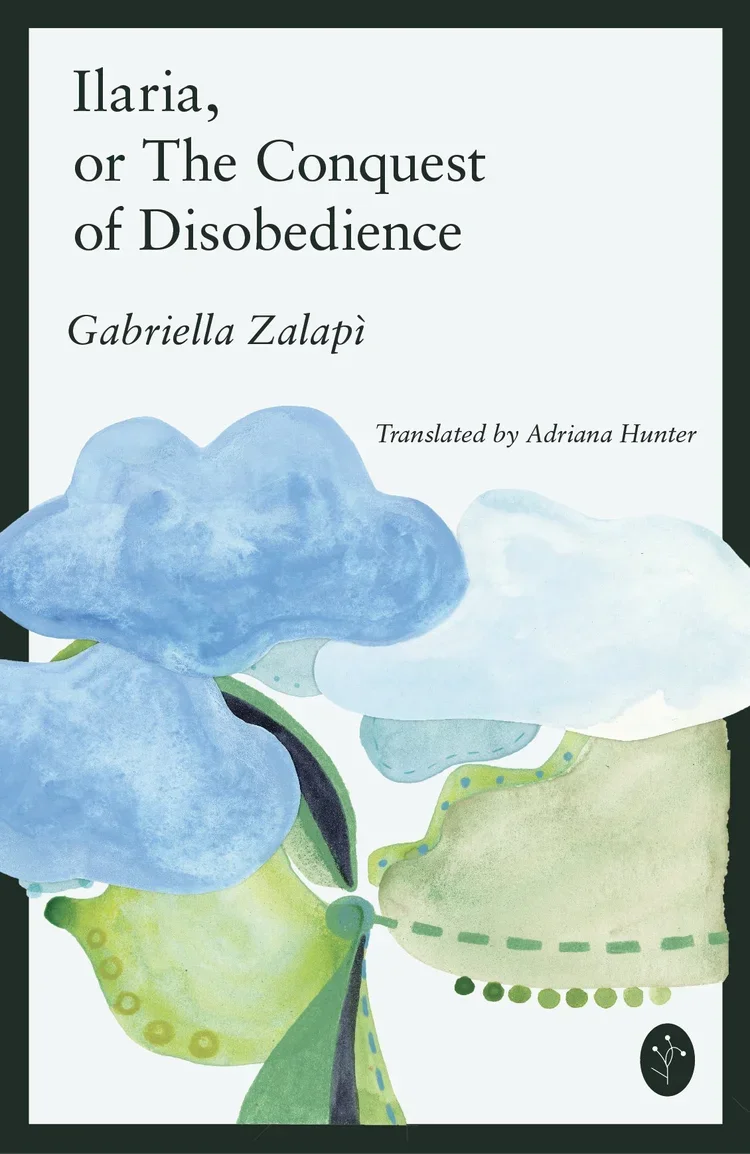
Ilaria, or The Conquest of Disobedience
Gabriella Zalapì
Translated from French by Adriana Hunter
Publication date: March 2026
Winner Prix Femina des Lycéens 2024 , Winner Prix Millepages 2024, Winner Prix Blù Jean-Marc Roberts 2024
-
One afternoon in May, 8 year old Ilaria gets into the car with her dad, expecting to go out to dinner with her mum and sister. Instead, she is taken across the border, on a whirlwind journey around Italy, from Trieste to Rome and Sicily, sleeping in roadside hotels, singing to the radio, and fearing her often drunk, but loving father. Torn between her life in Geneva with her mother and the seemingly never ending Italian road trip with her father, Ilaria doesn’t know who to side with in her parents’ acrimonious separation.
Throughout her travels, Ilaria meets new faces, learns how to light a cigarette, discovers when is best to keep quiet around her father, and finds comfort in her lovable teddy bear Birillo. Ilaria’s voice is singular and powerful; while her travels through Italy and the cast of characters around her create an unforgettable image of Italy .
This deeply moving novel explores the fear and confusion felt during this chaotic kidnapping, through the dreamlike eyes of the young girl. Intimate and poignant, Ilaria follows the life of a girl who is learning to navigate the world on her own.
-
“A propulsive coming-of-age story set against the political violence of Italy’s Years of Lead… Zalapì sketches a clear and sensitive portrait of her young narrator… This leaves a mark.” Publishers Weekly
“A nuanced portrayal of a child’s lost years with a flawed and irresponsible parent.” Kirkus Reviews
“The story captivates the reader with a precision as minimalist as it is disarming.” Vogue France
“A deeply moving novel about family love and its contradictions, the end of innocence, and the disobedience of a young girl looking for freedom.” Elle France
“A story tinged with dread but, above all, bursting with sensitivity.” Le Monde
“In a breathtaking novel, Gabriella Zalapi captures the sensations - nothing but the sensations, all the sensations - of a childhood torn between two parents.” La Tribune
“Gabriella Zalapi has the art of telling her own story as a smokescreen.” Le Nouvel Obs
“Her writing is all about intimacy in strangely charming books, juggling in all languages between limpidity and skilful blurring. Gabriella Zalapi or modesty incarnate.” Télérama
“This talented Anglo-Swiss-Italian writer has the talent of drawing us into personal and universal stories intermingling the sweetness and brutality of childhood, the hardships girls and women have to overcome to find their place in a world dominated by men who spread themselves out, all with words that glide and resonate with the same clarity, the same grace, as the song of a river flowing between rocks in the heart of a mountain.” Libération
"Gabriella Zalapì's achievement is to make palpable the feelings and inner world of this child, who looks around her with such maturity and gravity. " Sandrine Rovere, Le Regard Libre
"Gabriella Zalapi places her protagonist as narrator of her destiny... The book is at once terribly beautiful and anguishing." Mademoiselle Lit
"I was completely captivated by this story, its atmosphere, and its writing. A true favourite".” Joelle Books
"Through [Illaria’s] lucid gaze and timid child’s voice, we are told about a painful episode in her life directly inspired by the author’s own experience.” Anna Pheulpin, Zone Critique
-
This must be the seventh Saturday in a row that I’ve waited for Dad in the room reserved for parents. I’m here long enough to watch all the other girls come through, including the older ones I usually see only from behind during Mass. They change out of their uniforms into short skirts, makeup, and colorful scarves.
The nuns try to get hold of Dad. What are they to do with me? Do I have family in Rome? I give them Giuseppe and Loredana’s number. Sometimes it takes only half an hour and there he is on his motorbike. Giuseppe smells so good. Sitting on the backseat, I press myself up to his leather jacket and put my arms around his waist. The jolts over Rome’s cobblestones make me laugh. I’m scared but I hang tight because I know that I’m about to see Lucia and Maria and I’ll forget everything. With them, weekends are like a party. We fill our faces with ice cream, go for bike rides, and put together shows.
When Giuseppe can’t come to get me and Dad isn’t picking up, the days go on forever at school. While I wait for Claudia to return, I stay in the library and draw or make little books full of scribbles and slip them between the real books. Then life picks up again. Claudia tells me about her weekend at home and, as I listen, I think about the priest who says jealousy is a terrible sin.
Taking a large basin, filling it with warm water, dunking clothes into it and not forgetting to scrub the collars and cuffs with soap. Rinsing well. Sister Siliana says that otherwise my clothes will go all yellow when they dry.
We climb up to the terrace to hang out our laundry.
The plastic clothes pegs have been eaten away by the sun, some of them snap. Sister Siliana doesn’t get angry. She never gets angry.
When we’ve finished Sister Siliana helps me sit on the low wall. And from up there we can see roof terraces all over Rome. They’re full of plants. It’s like one big garden.
Sister Siliana points out buildings, domes, bell towers. She knows the names of all the churches.
“Can you see the Colosseum over there?”
For a long, long time I gaze at the open door that leads out to the street, then eventually let the sisters know I’m here.
This time, I’m in tears and Sister Siliana takes me to Mother Superior’s office. They call Dad together. But it’s no good. It’s your birthday today, isn’t it? We need to do something special! Sister Siliana suggests going to Luna Park. What do you say to that?
Mother Superior doesn’t look pleased.
Make sure you’re back in time for dinner, mi raccomando.
She hands some keys to Sister Siliana.
Yes, Mother.
Sister Siliana grips the steering wheel and knits her brow. I’m not scared, but I have to admit I don’t drive very often. True, she’s not as assured as Dad. Have you been to Luna Park before? Mi raccomando, we mustn’t get lost.
There’s loud music between the attractions. Bling-blang-blong. Win a scorpion in a bottle! Rifle shooting! Win thejackpot!
Do you want to? Do you want to try? No.
We end up buying caramelized almonds and watching people having fun on the bumper cars. So much happiness is dragging me down, I want to leave. But I don’t say anything. Sister Siliana goes to a lot of trouble to make me smile. How about a ride on the roller coaster? Go on! Come! We can’t leave without trying one of the rides, can we?
Our red car climbs and climbs and climbs, then glides and drops almost vertically on the rails. The metal screeches and thrums. How on earth don’t we go flying through the air? Ooohhh. Ohhh. Ahhh. We laugh and scream very loudly. Again and again and again. It makes me feel fantastic. Another go. Oh, my God! Sister Siliana’s voice betrays her fear. I cling to her. She clutches my hand and doesn’t let go until we have our feet back on the ground, our heads reeling. A fresh feeling has settled over my chest, I can take big deep breaths. The knot that was crushing me has dissolved.
The sky on this April day is blue. I’ve already been at boarding school for three months, and Dad isn’t here to celebrate my ninth birthday.
-
Watch a video of Gabriella Zalapì discussing her novel, Illaria, or The Conquest of Disobedience in English.