
-
The master got up earlier to do the milking. The hup now and the on you go of his groggy voice. The ragged breathing of the pumping milk. Sometimes I am allowed to drink the milk. Only mixed with blood.
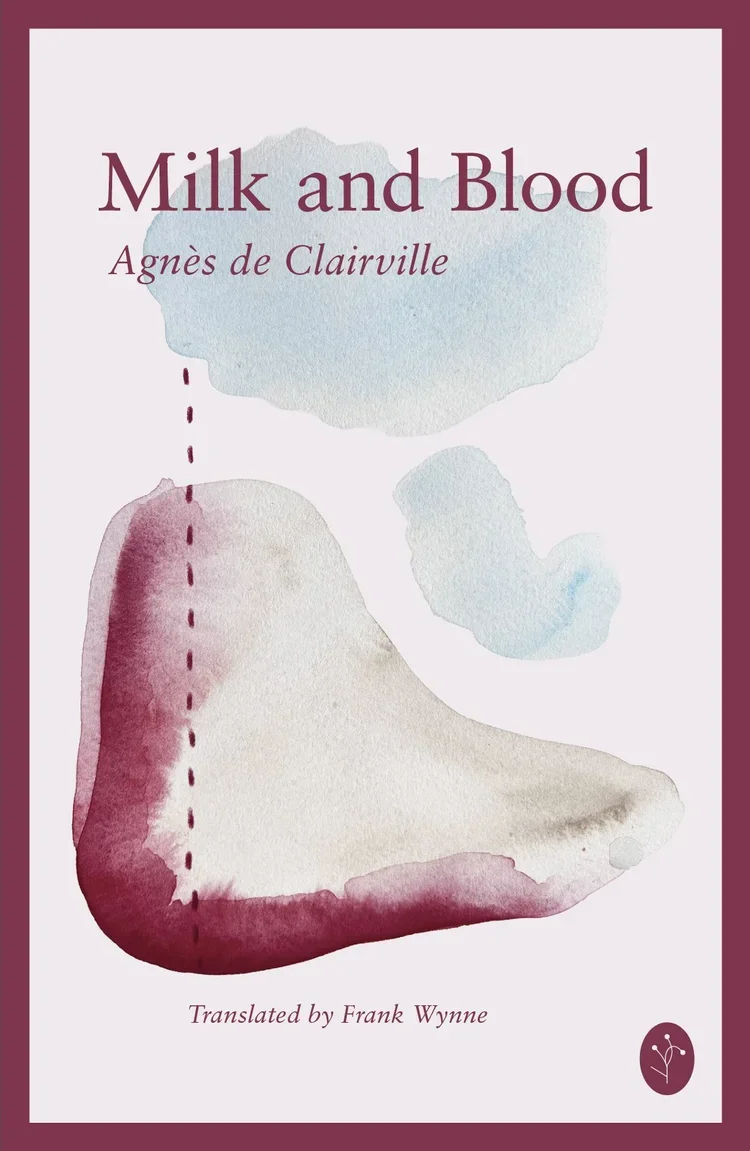
Deep in the French countryside, a farm holds its secrets close. The father buckles under mounting debts, two brothers circle each other in rivalry, and a mother tries desperately to carry the weight of the past. As the humans avert their gaze, it is the animals who bear witness, voicing the drama and violence that the humans strive to keep quiet.
Inspired by Virginia Woolf’s Flush, this choral novel gently turns perspective on its head, narrated by farm animals as they observe the humans who exploit, kill, and love them. There is the newborn calf who, expelled from the womb, is instantly removed from its mother. There is the spaniel, who spars with the tabby cat over the delicious colostrum from the calving cow. And then there is the magpie, who circles over the farmyard, missing nothing.
Death and life contract like a single, shimmering muscle, and a quiet devastation lies beneath the surface. Yet amidst this brutality, it is Clairville’s tenderness that is most affecting, as she draws poetry from mud and compassion from violence, in what is ultimately a declaration of love to those who feed us.
-
“Milk and Blood is a striking novel, totally original and gripping. Agnès de Clairville avoids any anthropomorphising and touches on a huge variety of topics. She knows the rural world inside out and questions our relationship to other living creatures as well as our very humanity.” Geraldine D’Amico, publisher
“I am thrilled to be working on Agnès de Clairville’s Milk and Blood — a lucid, angry novel about the rigours of farming life. Daringly, the multiple voices that narrate her second novel are those of the animals. But this is no Orwellian satire, nor is it a mawkish piece of anthropomorphism. It is a spare, meticulously detailed bucolic tragedy that pulses with passion and with anger.” Frank Wynne, translator
“A novel narrated entirely by farm animals has some precedent, but Milk and Blood by Agnes de Clairville (Linden Editions £12.99), translated with customary verve by Frank Wynne, is no George Orwell satire. Instead, the daily life of the inhabitants of a failing farm in the French countryside is brilliantly laid bare through the observations and polyphonic cri de coeur of the livestock, in chapters narrated variously by ‘the piebald cow’ and ‘the spaniel bitch’ whose survival is contingent on their ‘master’ and his family – who are, in turn, economically dependent on them.
It is also a summation of the brute practices of farming (de Clairville, who trained as a scientist, is necessarily unsentimental): ‘the lightning bolt hit my neck, throwing me off. How long was I unconscious, a second, a minute, an hour? The shock had paralysed every muscle. I no longer feel my ruptured teats, nothing but precise overwhelming pain in every organ, and I low, my mother lying limp before me.’ Beyond this world of agony and violence is human silence – and a dreadful family secret that only the animals witness and only the animals can betray.“ Catherine Taylor, The Irish Times
“Milk and Blood tells us with a rare force about birth, filiation and inheritance, denial and things left unsaid, a drama enacted in the wings, “behind closed doors but in the open”, where life and death meet again and again until they become one.“ Madame Figaro
“This pastoral tragedy, cleverly built around two parts which echo each other along the cycles of life and death, is a subtle anthem to those who feed us.” Le Monde
“Agnès de Clairville has not chosen to elevate animals towards civilisation but rather to bring the humans down to the mud in the stables.” Elle
-
The steady downpour that curtained the windows with rain has stopped. The barn is calling to me, though I know I will never find the young tabby. I leap over the puddles, tense and silent.
The hulking shadow of the barn is framed against the turbulent sky. I turn my back on it and creep into the building.
I let out a short mewl, unworried that the ginger tom will appear. It has been weeks since I last smelled his musky scent. The black queen responds with a curt meow. She is perched on the edge of a hay bale halfway up, watching her nearly weaned kittens roll around in the dust, chasing and biting each other. Stony-faced and motionless as a temple goddess, she does not intervene when the ginger kitten claws at the flanks of her other offspring. He attacks the little tabby more than his spotted brothers and sisters, cornering him until the kitten yowls for help and lashes a feeble claw that is easily dodged. The mother stares at me, already tired of her litter, of the battles between the kittens. In response to her silent plea, I swat the little bastard away with a flick of my paw, pick up the other by the scruff of the neck as though he still carried the scent of his mother and set of at a run, taking him out of his world, limp and paralysed, not daring to move between my fangs.
I carry my live booty back through the cat flap, climb the stairs without a problem and hide him in the far end of the younger boy’s bed, the part he cannot reach, curled up as he is on his drool-soaked pillow.
When he wakes up, it is his turn to be amazed as he picks up the living toy and cuddles it. He kisses it with his wet mouth and runs to show it to the mistress who is already standing at the cooker. She is briefly moved by the sight of the kitten, lifts him up, another tomcat. What on earth has got into you, cat? From my perch on the stairs, I pad down step by step, lick my pupil, and show him how to sit and wait for the whey, but he has not yet learnt to obey me, and explores the tiled floor with faltering steps, lets loose a little puddle that is quickly wiped up by the mistress. She grumbles, oh, come on, there’s still work to do, you’d better teach him fast, right?
And as though she has already forgotten the accident, she offers a saucer of good creamy milk. The fatty smell makes my whiskers tingle. Why I pick him up by the scruff of the neck and set him down in front of the saucer without so much as touching it, resisting this torture, I do not know. The farmer’s wife stares at us, hands on her hips, well I never. Well I never!