
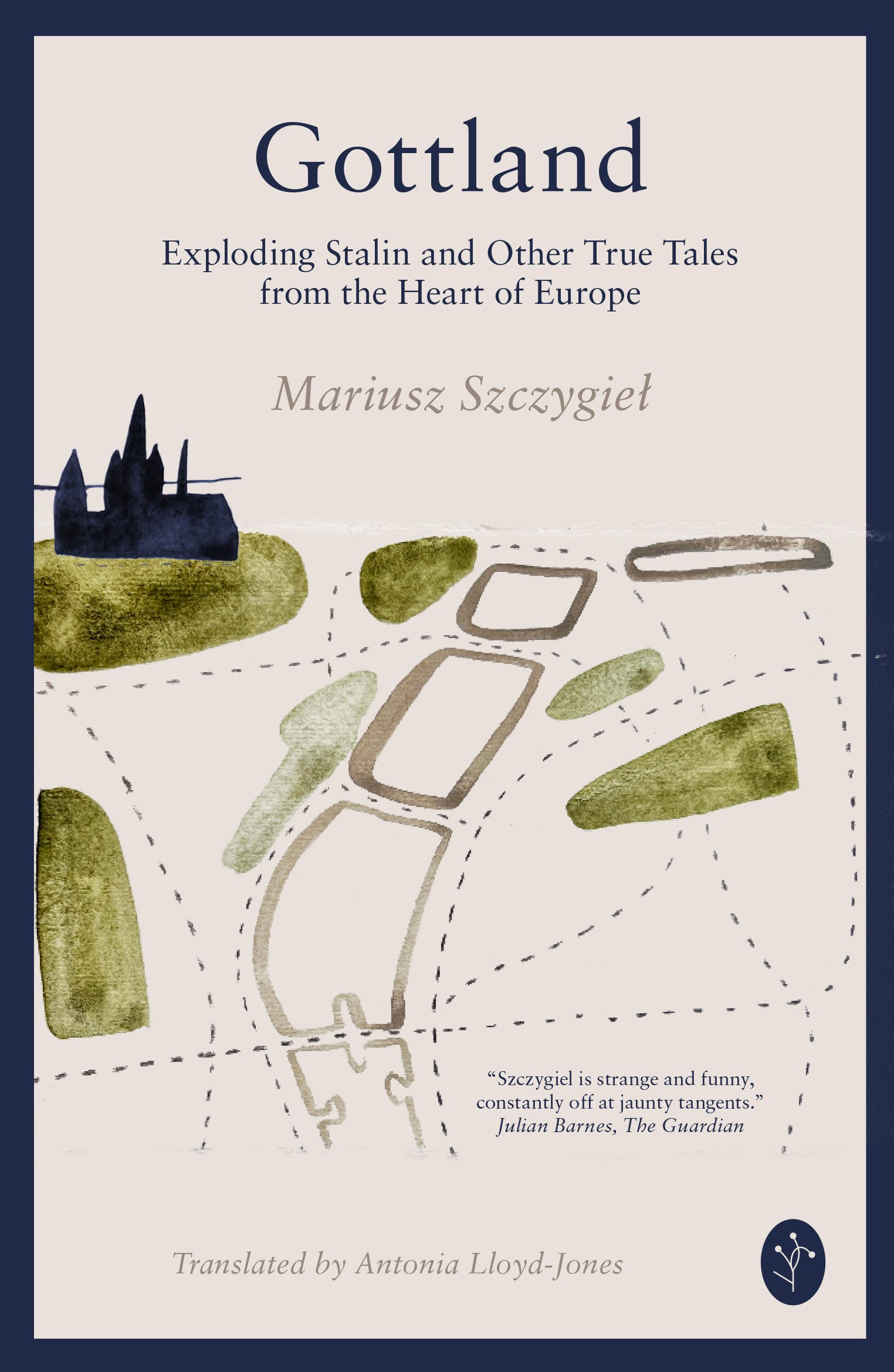
Gottland: Exploding Stalin and Other True Tales from the Heart of Europe
Mariusz Szczygieł
Translated from Polish by Antonia Lloyd-Jones
Publication date: October 2026
Winner of The European Book Prize
Price £12.99
-
Winner of the European Book Prize, Gottland is essential reading for anyone wanting to understand the history of modern Europe— a history of foreign occupation, a tussle between East and West and the extraordinary bravery of individual citizens living through these times. Gottland is a kaleidoscopic portrait of a nation living through extreme events. Kafka’ niece, the sculptor who made the world’s biggest statue of Stalin, Karel Gott, winner of the Most Favourite Male Singer Award a record thirty-six times and the Bata brothers and their shoe empire all gather in this landmark history written by a celebrated Polish journalist.
Through meticulous research and hundreds of interviews, Szczygiel creates a compelling portrait of the country that brought us Franz Kafka, Milan Kundera and Tom Stoppard. One of Europe’s preeminent investigative journalists and a Czechophile, Szczygiel is uniquely qualified to create this portrait of Czechoslovakia and its people in bizarre times.
-
“One of those delightfully unclassifiable books… Szczygiel is strange and funny, constantly off at jaunty tangents.” Julian Barnes
“Gottland offers an indelible account of the ravages of 20th-century totalitarianism and the way it continues to pollute human thought and behaviour in the 21st century.” New York Times
"A wonderful, strange, unputdownable work which masterfully blurs the borders between reportage and fiction." Justin Marozzi, author of Captives and Companions: A History of Slavery and the Slave Trade in the Islamic World
-
PROOF OF LOVE
…
As part of the celebrations for Joseph Stalin’s seventieth birthday held in December 1949,* the authorities decide that nine million of the country’s population of fourteen million citizens will sign birthday wishes for him.
* Joseph Vissarionovich Stalin should have celebrated his seventieth birthday in 1948. It seems that he falsely gave 1879 as his date of birth in many documents, and thus it was accepted as the official date during his lifetime. This is discussed by Russian historian Edvard Radzinsky in his book, Stalin: The First In-depth Biography Based on Explosive New Documents from Russia’s Secret Archives (Doubleday, 1996).
They manage to collect the signatures in four days. To mark the occasion, a decision is taken to erect the world’s largest statue of Stalin on a hill above the Vltava River in Prague.
No sculptor can refuse to take part in the competition. Fifty-four artists are given nine months to design a statue. Thank God, the top Czechoslovak sculptor Ladislav Šaloun is lucky enough to be dead (as they say about this particular death in Prague). In order not to win, Karel Pokorný, regarded as Šaloun’s successor, draws the leader with his arms spread in a friendly gesture, making Stalin look like Christ.
Most of the other artists make the same mistake. “They have presented Stalin in an affected way,” says the panel of judges.
Fifty-six-year-old Otakar Švec, son of a confectioner who specializes in sculptures made of sugar, is a frustrated sculptor.
After a strong debut, when as a student he sculpted a motorcyclist and successfully captured movement in stone, he designed a statue of the father of the republic, T. G. Masaryk, and then a statue of Jan Hus. Both were destroyed by the fascists during the war. After the war, he designed a statue of Roosevelt, but never completed it, because the communists took power. Before the war, he used to exhibit his avant-garde sculptures in the West. He thought he would never get another commission.
Now—so rumor has it—Otakar Švec throws together a model under the influence of a couple of bottles of vodka. He is a decent man, so he deliberately plagiarizes a well-known pre-war idea for a statue of Miroslav Tyrš, a bourgeois public benefactor whom the communists don’t like.
Unfortunately, he wins.
Stalin is standing at the head of a group of people. In one hand, he holds a book, and he rests the other hand on his chest, under his coat.
On the left—Soviet—side, Stalin is followed by a worker holding a flag, then an agrobiologist, then a female partisan and finally a Soviet soldier who is looking round behind him.
On the right—Czechoslovak—side of Stalin comes: a worker with a flag, a woman from the countryside, a scientist and a Czechoslovak soldier also looking backwards.
Some people start to whisper boldly that “there’s Stalin with everyone crawling up his ass.”
Just one of his buttons—they say—will be the size of a loaf of bread.
The monument will be one hundred feet high, and Stalin fifty feet wide, altogether the size of a ten-story pre-war building. His foot alone will be over six feet long.
The whole thing, made of granite (not at all suitable for sandstone Prague, but unlike sandstone, granite lasts for centuries) is to stand on Letná hill and provide competition for the castle. Its vast scale is to crush the past. It will be visible from the Old Town Square, and will stand on the other side of Čechův Bridge, across the river from the top of Pařížská Street.
To make a Stalin of this kind, 260 blocks of granite are needed, each well over six feet by six feet by six feet in size.
The fact that a quarry is found with thick enough walls from which to cut out such large blocks of stone of exactly the same color is little short of a miracle.
The two architects helping Švec—a married couple called Štursa—have to devise a way to prepare the weak sandstone hill for this colossus.
They decide that the hill will be filled from the inside with gigantic blocks of concrete, which will form something like underground halls.
Two years after the competition is announced, people start to voice their concerns about the statue. Švec’s sketches, models and drawings are exhibited to the citizens for their consultation, and a debate is held about “Prague’s new jewel.”
“I’m worried that from a distance the figures will merge into one and Stalin won’t be sufficiently visible.”
“Why are the last figures in line looking backwards? I find that too avant-garde,” people say, as the doubts increase.
“They’re looking back for ideological reasons,” replies Švec. “It’s to do with the guarantee of living in peace, it’s about defense. They’re also looking round for compositional reasons, so the monument will have a nice view from the back, not the rear end of a soldier.”
“Why as an artist do you want to defend our people on the monument, comrade?”
“A rearguard defense is necessary so that the people in the vanguard can feel calm,” explains the sculptor.
Later on, people will say that the figures behind Stalin are standing in line for meat.