
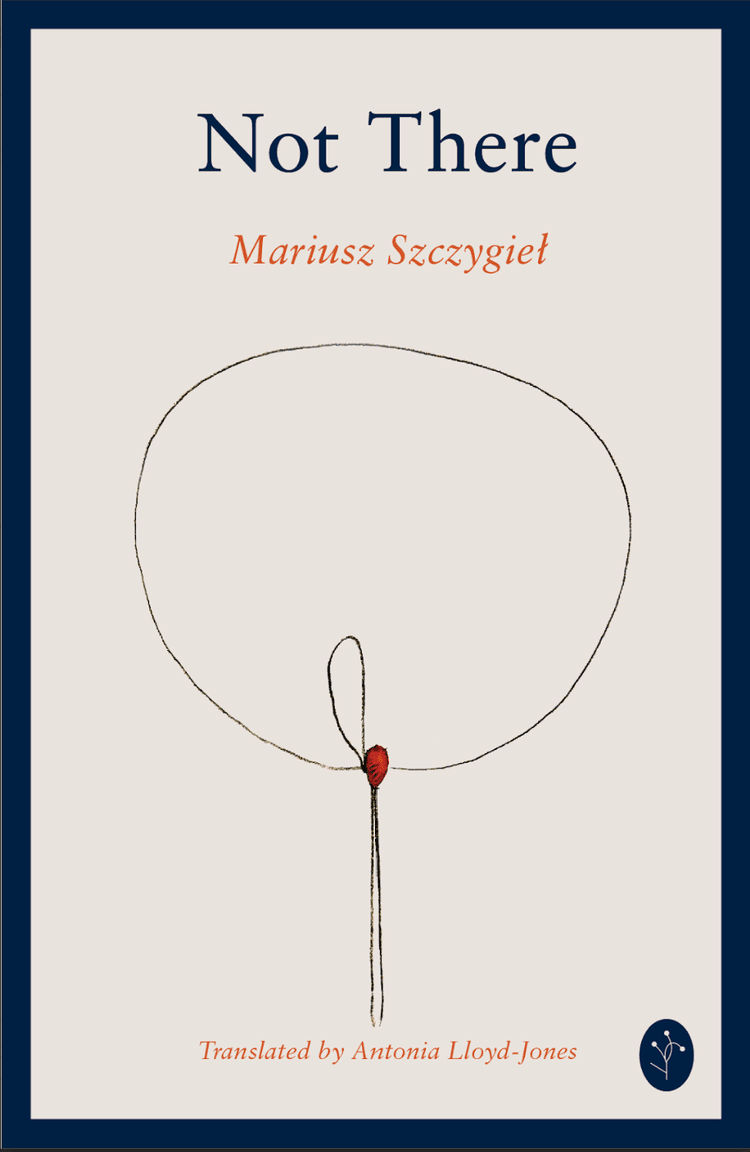
Not There
Mariusz Szczygieł
Translated from Polish by Antonia Lloyd-Jones
Publication date: 6th November 2025
Price £12.99
Winner Nike Prize 2019, Winner Nike Prize, Readers Selection, 2019
-
From Mariusz Szczygieł, one of the best reportage writers in Poland, comes a collection of literary essays about loss, absence and retaining memories.
-
“Loss is very much at the core of Mariusz Szczygieł’s Not There (Linden Editions, £12.99), translated by Antonia Lloyd-Jones. Across these fragments of reportage – portraits of a Czech poet, a Ukrainian soldier, a Polish accountant, an Albanian painter, the writer’s own father – Szczygieł traces the negative space left by loss (of a person, a colour, a cheese fork, a child), but if the book’s title suggests an inventory of losses, its pages are alive with the traces of what is not there: it is a meditation on absence that hums with the quiet pulse of what remains.....
Not There ultimately celebrates what endures: the stubborn glow of memory, the joy of small human continuities. In Szczygieł’s world, absence has its own heartbeat, one that reminds us that to write about what has disappeared is to affirm what is still present – the fragile, flickering persistence of being.” Frank Wynne, Irish Times
“Not There, translated once again by Lloyd-Jones, is full of weird variety and bounce. We get stories of a woman hunting in a library for books from her childhood, saving one of them just in time from the library’s ruthless ‘clearance’ procedures: ‘You see, my dear,’ the librarian coos at the rescued novel, ‘You’ve escaped selection, you’re going to go on living.’....Szczygiel takes pains to preserve tiny things for us: a snatch of dialogue overheard on the metro, or a conversation with a completely random stranger about the Czech national character.... Czech history – which still seems to obsess Szczygiel – is told through the prism of a single poem, or the history of a Prague house, the Loos-designed Villa Müller – ‘a star among villas’ – through whose exquisite Modernist rooms and stairways history seems to rampage. ‘We never remember the whole, just details,’ he explains. ‘I’m sure the detail is where the whole of something is reflected.’....‘So, here in this book,’ writes Szczygiel jauntily, ‘we’ve saved one postcard, perhaps more than just that.’ One can only agree with him: whole multitudes are saved in Not There from the ‘bomb of time.” Robin Ashenden, The Spectator
“Not There is about ordinary people and the things that have happened to them, and it’s impossible for the reader not to share the emotions underlying the stories as they prompt us to think of our own losses, and our compensations. It’s also about how we remember things – unreliably on the whole – and how our idea of the truth may be a very personal one.” Antonia Lloyd-Jones, translator
“Utterly riveting not only in terms of the storyline, but also in the philosophy underlying it … it certainly makes for one of Poland’s most impactful pieces of writing in the last years.” Maria Lewandowska, Literary Encounters of the Third Kind
"By far one of the best ones... it moved me in ways I did not expect.. a powerful book" Bookskeptic
"A book about death, longing, lack, emptiness ... Szczygieł created something unpretentious, sincere, subdued, and intimate ... freeing reportage from social servitude." Tomasz Wojewoda, Kuźnia Literacka
"A fragment of fine literature and a substantial piece of reportage. I recommend Not There, because it’s worth having." Paweł Stępień, Głos Kultury
"This is already another of his books that takes as its subject those moments of encounter with people about whom many an experienced reporter would say “there’s no story there.” From each person he describes, Szczygieł draws out an entire cosmos. Thanks to his immense sensitivity, he will not run out of subjects until the end of his life, nor, for that matter, of readers." Aktivist
(Translated) "Between the collection of reportages, essays, quotes and short stories, a tension is born which I haven’t felt in Polish literature for a long time... I think it is obligatory reading, because contrary to the title there is something in it which was missing until now. And that is probably ‘truth’.” Wojciech Szot, Zdaniem Szota
-
The Solider
He’s come back from the war.
He spent a year and a half at the front.
He’s sitting before an audience in a fairly large room. They have lots of questions, because it’s rare for us to have someone from a war here.*
* The ‘Pictures of War’ event – Paweł Pieniążek in conversation with Mykhailo Kryven, a volunteer in the National Guard of Ukraine – took place on 4 July 2017 at the Wrzenie Świata bookshop in central Warsaw.
Is he talking too quietly into the microphone, or isn’t it switched on? It is on – it’s that he’s talking too quietly.
He doesn’t really want to say anything, and prefers to show photographs on a screen behind him. He shows 180 of them. ‘Soldiers at war love to have their photo taken,’ he says. ‘They’re extremely eager to pose. Why do they like it so much? I don’t know,’ he says.
The photos he has taken of the other soldiers at the front are excellent, because they’re not nice. They’re not trying to please. And they wouldn’t be able to please anyone in Poland anyway. Soldiers sitting over a game of chess. Soldiers sitting on earth dug out of trenches, doing nothing. A soldier eating something from a metal bowl. Two of them sitting, that’s all. ‘And these are selfies. They were all taken at a place called Krymske, ladies and gentlemen, near Luhansk.’
‘Soldiers with computers. Playing games. What were they playing? A game called Counter-Strike, for instance, terrorists against anti-terrorists. And in World of Tanks you drive tanks on your mobile phone.’
‘What’s that? You play war games at a war?’
‘At the front,’ he explains, ‘there’s a short burst of fighting and then hours and hours of boredom. Two hours of shooting, for instance, and then what?’
The audience asks if in that case he can tell them about the war.
‘Can you talk about Chopin’s music with your fingers?’ he says.
So there are the photos behind him. One of the soldiers has a card stuck on his backside that reads: ‘PUTIN IS A DICKHEAD. LA LA LA LA.’ ‘That’s a song we sang, to a very simple tune.’
The audience asks what the soldier’s profession is.
A radiology engineer. His closest friends in the squad are a businessman, a teacher and a writer. They gave up their jobs and enlisted for the war.
The audience wants to know if it was worth engaging in armed conflict against the separatists.
‘I don’t know,’ says the soldier.
‘And is…?’
‘I don’t know… so I’ll tell you something else – I was desperate for sweet things. We drank a lot of coffee, or rather, we didn’t drink much coffee, because we only poured a drop of it into each mug, but then we added lots and lots of sweetened condensed milk. That was what everyone actually wanted, all of us. Before then, I’d never eaten sweets or cakes at home, but
suddenly I couldn’t live without them. I wonder why? I have no idea.’
The audience asks the radiology engineer: ‘When you’re at war, do you shoot to kill?’
‘You shoot,’ he explains. ‘But you’re glad the people you’re firing at are firing too.’
‘How come?’ The audience doesn’t understand.
‘Because if they’re firing at you it means they’re alive and you haven’t killed them… At the front, it was a problem that people’s phones went on ringing – that was a real nuisance.’
‘Yes, mobile phones ring at the front. For instance, my wife would call, from Ivano-Frankivsk. Once, in the middle of a dangerous bombardment, she called and asked: “There are no cheese forks.” “What??” “Where are the cheese forks?” “I can’t talk now, they’re firing at us!” Anyway, my wife’s here in the audience, she can tell the story herself.’
‘It’s true, I did make that call, a week after he left for the front. Because a friend came by, we made fondue, and you don’t use ordinary forks for that. I couldn’t find the special fondue forks anywhere. My husband hung up, so I started looking but I couldn’t find them. Fifteen minutes later I rang him again, because he had to know where they were. He said he didn’t.’
‘Did she ever find them?’ asks the audience.
‘Yes. They were in a drawer.’