
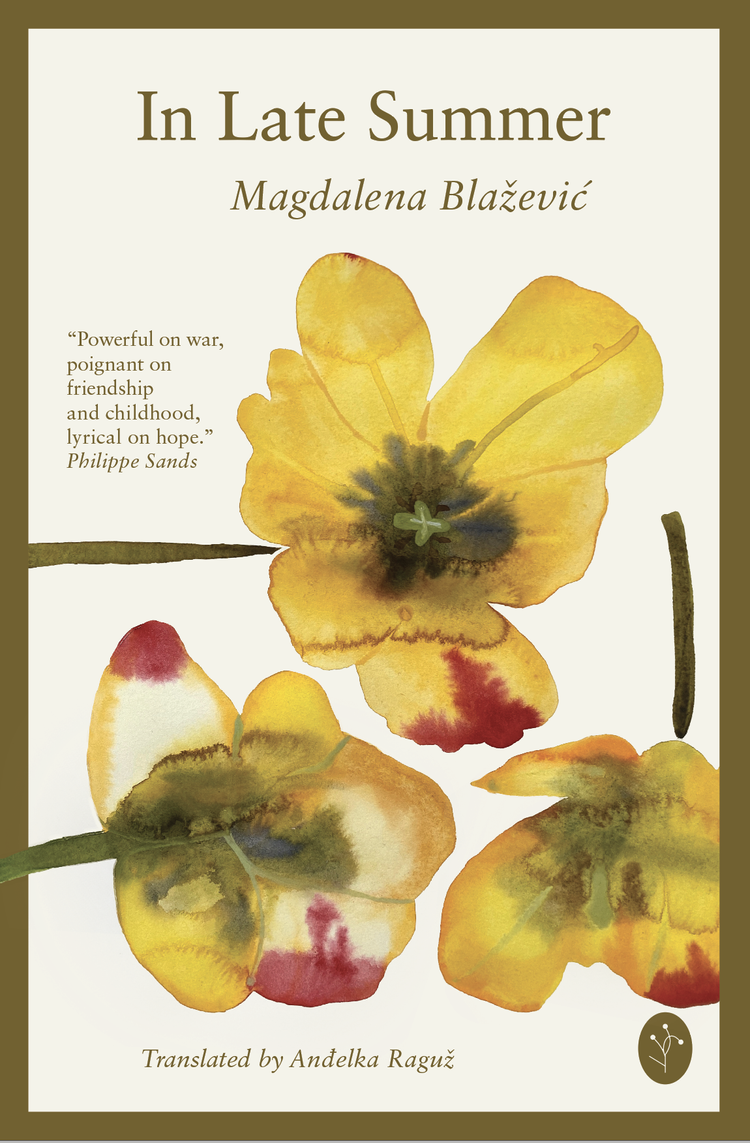
In Late Summer
Magdalena Blažević
Translated from Croatian by Anđelka Raguž
Publication date: 15th April 2025
Price: £12
Winner of the 2022/23 Tportal Award
Shortlisted for the 2026 Dublin Literary Award
-
In Late Summer is written from the perspective of a 14-year-old girl killed in the August 1993 massacre in Bosnia. When a picturesque village is caught in the turmoil of war, the entire worlds of girls Ivana and Dunja and their families are blown up and swept away.
Based on a personal experience, Magdalena Blažević’s novel is poetic and powerful, full of images of ordinary country life as well as the brutality of war. This is a haunting portrait of a family and a village, each affected differently by the daily realities of civil war. Compared by critics to Ingeborg Bachmann, Blažević weaves emotion under the surface of her precise and lyrical prose.
-
“Powerful on war, poignant on friendship and childhood, lyrical on hope. An Impressive, strong and original voice, which touched me particularly, having spent fifteen years litigating these issues in various courts.”Philippe Sands
“Permeated with beauty and pain, Magdalena Blazevic’s world sucks you in from the first pages. She has drawn and immemorialised a microcosm where love dwells forever, and where nobody is safe from the virus of war. It is a resoundingly timely and timeless story.” Kapka Kassabova
"In Late Summer is like a song of innocence in the face of war. Magdalena Blazevic creates a special rhyme and melody to tell the story of two young girls who are full of hope and joy, while their horizon is surrounded by unspoken evil. This is a book of promise for a beautiful world with the language of life." Burhan Sönmez, President International PEN
“A shockingly powerful and authentic voice dominates, a poetic howl stronger than any brutal and naturalistic representation of war.” Elizabeta Hrstić
“It’s the most powerfully moving and brilliant novel I’ve come across in a long time. The writing and translation are just exquisite – so sensual and evocative, the imagery so original and striking. I can’t praise it enough. And the production quality is superb.” Ros Schwartz
“A beautiful and terrifying book about a female world, consistently told until the end from the women’s perspective.” Miljenko Jergović
"This is an outstanding anti-war novel, in which war is scarcely mentioned.”Josip Mlakić
“In Late Summer is a work of limpid beauty drenched in sorrow…. above all it stands as a memorial to, as Blaźević’s dedication states, “the citizens of Kiseljak, in memory of 16 August 1993”. Catherine Taylor, Irish Times
"Based on a personal experience, Magdalena Blažević‘s novel is poetic and powerful, full of images of ordinary country life as well as the brutality of war. This is a haunting portrait of a family and a village, each affected differently by the daily realities of civil war. Blažević weaves emotion under the surface of her precise prose." Dublin Literary Award
"This is one of my favourite books of recent years… [In Late Summer] mixes rural beauty and the horror of war" Winstonsdad’s Blog
"As in Sara Nović’s Girl at War, the child perspective contrasts innocence and enthusiasm with the horror of war." Rebecca Foster, Bookish Beck
"Blažević tells her story very well, as we see the normal life of normal people suddenly brutally disrupted for no apparent reason. At the end life goes on, life and death" Mia Couto, The Modern Novel
-
THE SMALL SUITCASE
The double bed rises like a dumper. Mother sleeps turned towards the window, the embroidered net curtains and thick green blackout curtains. I see her opening them in the morning. She drapes the bed covers and fluffed pillows over the windowsill to air out. Small goose feathers and slow dust motes fall out of them. Her nightgown open at her large, saggy breasts, her sleeves rolled up. Mother’s skin is dark, but thin and translucent, as smooth as a bat’s wing. Her eyes are green glass, bottles full of bubbles. From the window, their gaze falls on the well lid with the iron handle, on the tap with the old water hose coiled around it and on the thin pear tree whose fruit are hard until winter. No birds or bees dare to land on it.
Under the bed, the scent of yellowing pressed linen and coats; the sachets of dry flowers have lost their perfume. Under the coats is a small black fake-leather suitcase with wonky silver buckles. A small accordion drops out of it and hits the floor with a drawn-out dissonance. Nobody knows how to play it. Inside, the suitcase is lined with golden-yellow cardboard.
‘Don’t overfill your suitcases; we’ll be back soon,’ Mother says.
I pack two pairs of shorts, a dress, some T-shirts, a notebook, pencils and a toothbrush into the small suitcase. Sivka wraps herself around my legs and meows. I let her into the house even though Grandmother says that a cat’s place isn’t in the house, and that you can die if you swallow a cat hair.
I’m separated from Dunja’s house by a large vegetable and flower garden. It’s edged with chrysanthemums and sunflowers. The sunflower stalks are needle-like, the leaves hairy, still green, and beanstalks coil around them in the same way that the ivy wraps itself around the trees along the riverbank. The flower bed is soft from all the digging and watering, which is why Mother goes into the garden in rubber galoshes. Later, she puts them, heavy with mud, on the grass by the tap. Grandfather also planted a domestic variety of apple tree on the slope above Dunja’s house. The fruit are large and green. Round children’s heads. They fall from a great height and crack on the ground. The cracked flesh rots quickly. Dunja says that at night small rodents visit the garden and feast on the fruit. That’s why there are deep holes in the fallen apples. The tree outgrew the house a long time ago and casts its shadow over the skylight. The skylight is full of stars when the night skies are clear, and then there’s no point reading. The shelf next to Dunja’s bed is crowded with books, some of which we took from the school library. The roof had fallen in, and bundles of books were lying scattered on the floor. We picked up two bundles: that was all we could carry. Dunja said it wasn’t stealing, because the books would have been destroyed by mould as soon as it rained.
Dunja kneels in front of her billy goat, Bekan, who is tied to a stake. Camomile blooms in the field in front of the house. She sees me and jumps up.
‘Bekan and Sivka have to come with us!’
She’s afraid that Grandfather will forget to feed them, and animals can go crazy from hunger.
Aunt and Dunja have already packed their bags.
The air has stilled, like it does in winter when the temperature drops below zero. The silence is cut at times by the mooing of cows and the squealing of pigs that refuse to be forced out of their barns and sties to be slaughtered. Sivka waits for me on the doorstep. My leg hurts and I walk slowly because of the tight bandage around my knee. I open the door and let her into the house. I take tiny walnuts out of a hamper and scatter them around the pantry, and I put Sivka inside. I fasten the lid with a piece of old wire. Mother looks at me reproachfully but says nothing; she just dismisses me with a wave of her hand. We barely have time to buckle up the suitcases, my brother is already carrying them out front. Grandmother is already sitting on the well lid and tightening the knot on her headscarf behind her head. Tears stream around her nose towards her thin, pale lips, into her toothless mouth. Grandfather comes out of the cellar and puts her suitcase on the grass.
-
Listen to Magdalena Blažević speak to Susan Curtis about In Late Summer, her debut novel in English.
Read Magdalena Blažević’s piece in Pen Transmissions on the massacre of Kiseljak: “The Wolf No Longer Lives in the Dark Hallway”.
Watch Magdalena Blažević read extracts from In Late Summer in English and Croatian.